

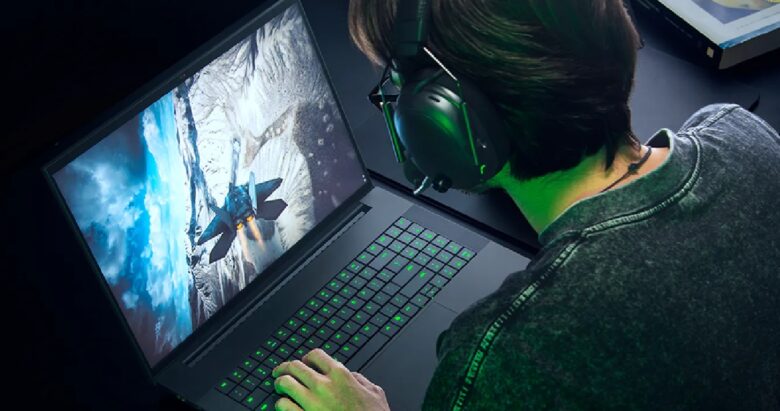
Razer has introduced the 2026 Razer Blade 18, positioning it as its most powerful laptop to date and expanding its focus beyond gaming to address the growing demands of AI developers, content creators, and professionals seeking desktop-class performance in a portable form factor. The latest flagship combines Intel’s newest processors, NVIDIA’s latest RTX graphics, high-speed memory, and advanced connectivity to support increasingly compute-intensive workloads.
The new Blade 18 is powered by up to the Intel Core Ultra 9 290HX Plus processor, featuring 24 cores and clock speeds of up to 5.5GHz. Graphics options scale up to the NVIDIA GeForce RTX 5090 Laptop GPU with 24GB of VRAM and up to 175W Total Graphics Power (TGP), enabling users to tackle demanding AAA games, AI model development, large language model (LLM) inference, and creative workflows from a single machine.
One of the standout features of the 2026 Blade 18 is its 18-inch Dual-Mode IPS display, allowing users to switch between UHD+ resolution at 240Hz for detailed creative work and FHD+ at 440Hz for competitive esports gaming. Razer says the display is 20% brighter than the previous generation, delivering improved visibility while maintaining the flexibility required by different workloads.
Recognizing the rapid adoption of AI across industries, Razer has optimized the Blade 18 for local AI development. The system supports up to 128GB of DDR5 memory, enabling developers to run large AI models, perform fine-tuning, execute computer vision workloads, build retrieval-augmented generation (RAG) pipelines, and generate AI-powered content without relying exclusively on cloud infrastructure. The integrated Neural Processing Unit (NPU) within Intel’s Core Ultra platform accelerates background AI tasks, allowing the GPU to focus on model execution and inference.
The laptop also leverages NVIDIA’s latest AI technologies, including DLSS 4.5 Multi Frame Generation, Reflex 2 with Frame Warp, and NVIDIA Studio optimizations, delivering enhanced gaming performance while accelerating AI-assisted creative applications such as video editing, 3D rendering, image generation, and digital content production.
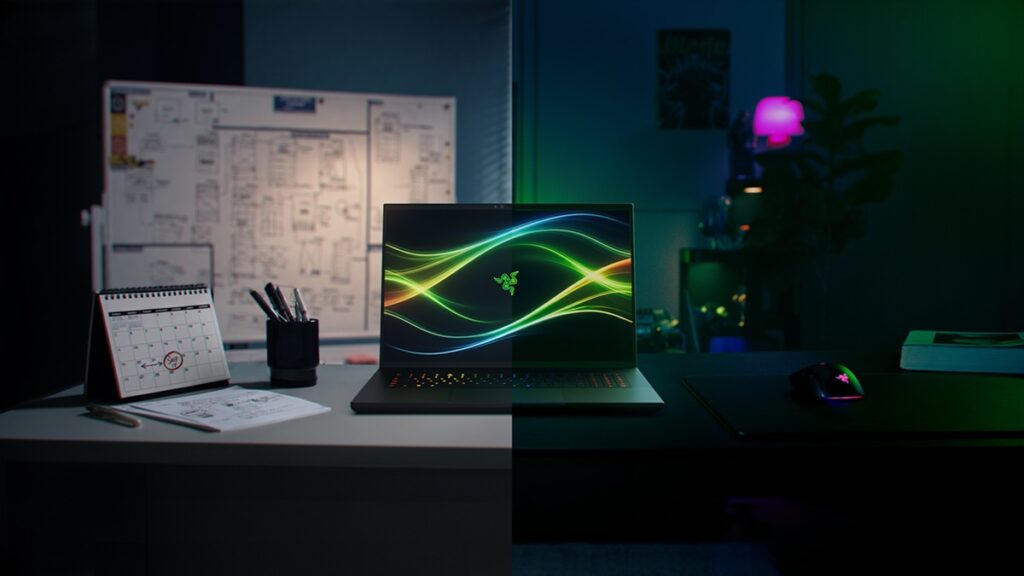 Connectivity receives a significant upgrade with the inclusion of Thunderbolt 5, offering bandwidth of up to 120Gbps for high-speed storage, multiple displays, docking stations, and external devices. Additional ports include Thunderbolt 4, HDMI 2.1, USB-A, Gigabit Ethernet, an SD card reader, Wi-Fi 7, and Bluetooth 5.4, making the Blade 18 suitable for complex workstation setups without requiring additional adapters.
Razer has retained its signature CNC-milled aluminum chassis while incorporating one of its largest vapor chamber cooling systems to sustain peak CPU and GPU performance during extended gaming sessions or intensive AI computations. Despite housing flagship components, the Blade 18 remains relatively slim for its class, reinforcing its position as a premium desktop replacement.
The new Blade 18 is available with multiple configurations. Entry-level models start with an Intel Core Ultra 9 275HX processor and RTX 5070 Ti graphics, while higher-end variants feature the Core Ultra 9 290HX Plus paired with RTX 5080 or RTX 5090 GPUs. Storage options include PCIe Gen4 SSDs, and memory configurations range up to 128GB.
Industry observers note that Razer’s strategy reflects the convergence of gaming, AI development, and professional content creation into a single high-performance computing category. Independent early reviews have praised the Blade 18’s exceptional performance, premium construction, expansive port selection, and strong battery life for a system of its size, while noting its premium pricing.
With the 2026 Blade 18, Razer is broadening its addressable market beyond gamers by targeting AI engineers, software developers, creators, and professionals who require workstation-class computing capabilities in a portable system. The launch reflects the growing demand for devices capable of handling both next-generation gaming and increasingly sophisticated AI workloads locally, reducing dependence on cloud infrastructure while offering users greater flexibility and control.